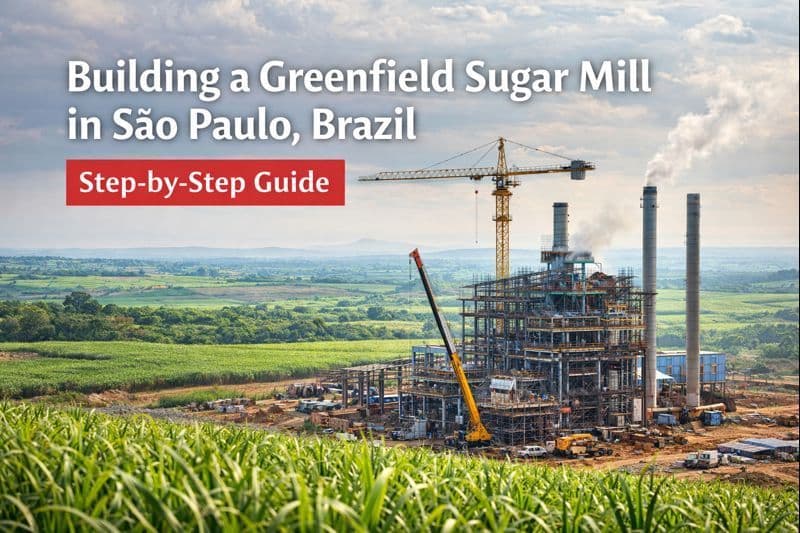
Setting up a new sugar mill (“greenfield” project) in São Paulo requires careful planning, significant capital, and adherence to Brazilian regulations. São Paulo is Brazil’s leading sugarcane region, ideal for producing raw (VHP) sugar and refined white sugar. This guide outlines each step – from site selection through construction and startup – with typical timelines, costs, and risk mitigation strategies.

1. Site Selection: Why São Paulo?
São Paulo (SP) state offers distinct advantages over other regions for a sugar mill:
Abundant Cane Supply: SP is the largest sugarcane-producing state, accounting for roughly half of Brazil’s cane (about 54% in recent years, versus ~11% in Goiás and ~10% in Minas Gerais). The dense cultivation ensures ample feedstock within a reasonable radius.
Infrastructure & Logistics: The state has well-developed roads and rail links and proximity to the Port of Santos (Brazil’s main sugar export port). In 2023, sugar made up ~16.7% of exports by tonnage at Santos, underscoring its role in sugar logistics. This connectivity lowers transport costs for cane delivery and sugar exports.
Industrial Cluster & Skilled Labor: SP’s long sugar industry history means existing processing plants, equipment suppliers, and experienced workforce. For example, Brazil’s leading sugar equipment maker, Dedini S.A., is based in SP and has supplied the majority of mills nationwide. Access to skilled engineers, technicians, and farm contractors is better in SP than remote areas.
Market Access: A mill in SP can serve both export markets and Brazil’s largest domestic consumer market (the Southeast region). Being near major cities enables distribution of refined white sugar to food industries and retail.
Stable Agronomic Conditions: SP’s climate and soil are highly suitable for sugarcane, with high yields and established research support. The region has advanced agricultural practices (mechanized harvesting, varietal R&D) that boost productivity.
Comparison to Other States: Other states like Goiás or Mato Grosso do Sul offer cheaper land and potential tax incentives, but they may have less developed transport and fewer skilled workers. In São Paulo, land and compliance costs are higher, and competition for cane can be intense (many mills operate in SP). However, the reliability of supply chain and infrastructure often outweigh those costs for a private sugar venture focused on quality and export.
Site Selection Criteria: When choosing the exact site in SP, investors should consider: distance to cane fields (ideally within 30–50 km to minimize cane haulage time), availability of a large contiguous land parcel (for the plant and future expansion), access to highways/rail, a water source (river or aquifer) for processing needs, grid connection (for backup power and potential export of surplus electricity), and suitable zoning. A thorough feasibility study will evaluate multiple candidate sites against these criteria.

2. Regulatory and Environmental Approvals
Building a sugar mill in Brazil entails navigating federal, state, and local regulations. Key approvals and their typical timelines include:
Environmental Licensing: This is often the lengthiest step. A new sugar/ethanol mill is classified as a potentially polluting project, requiring an Environmental Impact Assessment (EIA) and report (RIMA) for a full license. Brazil’s process has three stages: Preliminary License (LP) – approves site and concept; Installation License (LI) – allows construction; and Operation License (LO) – allows operation. By law, authorities should decide on license applications within 6 months (standard projects) or 12 months if an EIA/RIMA is required. In practice, large projects often take around a year or more to clear all environmental permits (including public hearings and impact studies). A new General Licensing Law in 2025 sets maximum review deadlines (~12 months) and even special expedited licenses (LAE) for strategic projects to streamline approvals. Early engagement with São Paulo’s state environmental agency (CETESB) is critical to meet all requirements (e.g. emissions control, effluent treatment, waste management plans).
Land and Zoning Permits: Acquire or lease of land must comply with local zoning for industrial/agro-industrial use. In SP, many sugar mills are in rural zones designated for agro-industry, but a municipal permit or land-use change might be needed. Verify there are no legal restrictions (e.g. protected areas or water protection zones) on the chosen site. Securing land can take several months including due diligence on title and any environmental liabilities.
Water Use Rights: Sugar mills consume significant water for cane washing, juice extraction, and boilers. If drawing from surface or groundwater, a water use permit must be obtained from state authorities. This involves hydrological studies and ensures that withdrawal won’t harm other users. The permitting process may take ~3–6 months and often runs concurrently with environmental licensing.
Construction and Building Permits: Before breaking ground, local authorities (municipal) will require building permits for structures. This involves submitting engineering drawings for approval (structural, electrical, etc.) and adhering to fire safety codes, occupational safety regulations, and sanitation codes. These reviews typically take a few weeks to a few months. Working with experienced Brazilian engineering firms can smooth this step as they are familiar with code compliance.
Operational Licenses and Certifications: Once construction is complete, additional certifications are needed to begin production. These include the Operational License (LO) from the environmental agency (confirming all environmental measures are in place) and inspections of boilers/pressure vessels by labor ministry agents. Food safety registration with the Ministry of Agriculture (MAPA) may be required for sugar production facilities (especially for refined sugar, to ensure food-grade standards). Allow 1–2 months for final inspections and approvals leading up to commissioning.
Estimated Timelines: In total, securing all major approvals can range from 12 to 24 months for a greenfield mill. Environmental licensing is usually the pacing item – expect roughly 12 months if an EIA is processed efficiently, potentially longer if there are objections. Brazil’s licensing reform aims to cap timelines at 1 year for most cases, but it’s prudent to budget extra time for unforeseen delays or additional information requests. Early and proactive compliance (hiring legal and environmental experts, engaging community stakeholders) is the best strategy to keep the regulatory timeline on track.

3. Infrastructure Requirements
A sugar mill project must either have or develop robust infrastructure to support construction and operations:
Land: The mill site itself may span 50–100 hectares for a small-to-medium mill (including space for the processing plant, storage warehouses, treatment ponds, offices, etc.), and well over 100 ha for a large complex with cogeneration and refinery. Ensure the site has room for future expansion (e.g. adding an ethanol distillery or increasing crushing capacity). Surrounding agricultural land is also critical – a rule of thumb is several thousand hectares of cane are needed to supply the mill. For instance, a 5,000 TCD mill (crushing ~1 million tons cane per year) might require on the order of 15,000–20,000 hectares of cane fields (depending on yields and harvest cycles). In São Paulo, a mix of company-owned plantations and independent growers’ fields will supply the cane. Securing long-term supply agreements or land leases well in advance is essential to guarantee feedstock.
Transportation Access: Road connectivity is vital since harvested cane must be quickly transported from fields to the mill (cane quality degrades within 24–48 hours). The site should be near quality all-weather roads; ideally, it connects to state highways for inbound cane trucks (which can be 30–40 ton trucks) and outbound shipments of sugar. Upgrading or building access roads may be part of the project if none exists. Many São Paulo mills are also rail-linked or reasonably close to rail lines, enabling bulk sugar shipment to the Port of Santos or domestic markets. If feasible, a rail spur for the mill can be a long-term advantage for export-focused operations (noting that ~35% of Brazil’s sugar exports ship via Santos). During construction, heavy equipment and materials will also be transported in, requiring road capacity for oversized loads.
Power and Steam: Sugar mills are energy-intensive but also energy-producing. The burning of bagasse (cane fiber byproduct) in boilers generates steam for process heat and for driving turbines to produce electricity. Cogeneration: A modern mill typically installs high-pressure boilers and turbo-generators to not only be self-sufficient in power but export surplus electricity to the grid (a revenue stream). São Paulo’s grid is well-developed; connecting a cogeneration plant to the grid requires an interconnection permit from ANEEL (Brazil’s electricity regulator). Initially, during construction, grid power will be needed to run equipment – ensure a reliable power line to the site or have generators on standby. Designing adequate boiler capacity and a power house is part of infrastructure – a medium mill might have, say, a 30–50 MW turbine, while a large one could install 100+ MW, depending on cane throughput and export plans.
Water Supply and Treatment: Water is used for extraction, cooling, and cleaning in a sugar mill. A steady supply of fresh water (from a river, reservoir, or wells) is required. As a guideline, a plant may need several cubic meters of water per ton of cane crushed (though many systems recycle water heavily). Infrastructure includes intake pumps, raw water treatment (to remove solids, etc.), and a distribution network around the mill. Equally important is effluent treatment: process wastewater and runoff (often containing organic matter from cane juice, cleaning agents, etc.) must be treated to meet environmental discharge standards. Typically, mills build settling ponds, anaerobic lagoons, or aerobic treatment plants to handle effluent. In Brazil, liquid byproducts like filter cake (mud) and boiler ash are often reused in fields as fertilizer, and vinasse (if ethanol is produced) is applied to cane fields via fertigation – the site should plan for pipelines or tanker routes for these byproducts. Designing drainage and containment for rainwater (to avoid contaminant runoff) is also necessary.
Cane Handling and Storage: Infrastructure on-site includes the cane unloading yard with ramps or cranes to receive cane from trucks, large weighbridges (truck scales) to measure cane weight (for payment to suppliers), and a cane yard with perhaps a short-term storage or staging area (though typically cane is processed immediately). Covered warehouses will be needed for sugar storage – raw sugar is often stored in bulk piles in large sheds, while refined sugar may be stored in silos or bagged and palletized in warehouses. The size of these depends on production; e.g. a smaller mill might have storage for 1–2 months of output, whereas a large export mill will have massive warehouses or silos to accumulate sugar for shipment.
Auxiliary Facilities: A complete sugar mill infrastructure will also include: maintenance workshops (for heavy vehicle and machinery repairs), a laboratory (for quality control of juice and sugar), fuel storage (diesel for farm equipment or backup generators), administrative offices and worker facilities (canteen, medical first aid station, etc.). If the site is remote (less likely in populous SP), housing or transport for workers might be needed; in SP, typically workers commute from nearby towns.
Summary: Choosing a site with existing infrastructure (roads, grid, nearby towns) can save costs and time. The project should budget for any new infrastructure development in the capital cost – e.g. road improvements, extending high-voltage lines, building a water pumping station, etc. Close coordination with local authorities can sometimes secure co-investment in infrastructure, given the economic benefits (job creation, etc.) a new mill brings.

4. Engineering and Construction Phases
Building a sugar mill is a complex project divided into multiple phases. Below is a step-by-step breakdown with typical activities and durations:
- Feasibility Study & Project Planning (3–6 months): This initial phase involves market analysis (sugar price outlook, domestic demand), technical feasibility (cane supply assessment, process selection), and financial modeling. A detailed feasibility report guides decisions on plant capacity (e.g. start with 5,000 tons cane per day crushing, expandable to 10,000 TCD), product mix (raw vs refined sugar ratio), and co-products (consider adding ethanol now or in future). It also evaluates site options and generates an initial budget. Securing project financing often hinges on the feasibility study outcomes. (In parallel, initiate environmental impact studies as noted in section 2.)
- Basic Engineering Design (3–4 months): Once the project is deemed viable, engineering firms (often specialized in sugar industry) prepare the basic design. This covers process flow diagrams, key equipment sizing, general plant layout, and initial civil engineering plans. Decisions are made on process technology (e.g. use a diffuser or milling tandem for cane crushing, sulfurous or phosphoric process for refining), and material balance calculations for cane, sugar, bagasse, etc. The basic design is used for budgeting and for beginning the tender process for major equipment.
- Financing and Procurement (overlapping, ~6+ months): During detailed engineering, the company secures financing (loans, investors) and simultaneously procures long-lead items. Procurement includes specifying and ordering the core machinery: crushers/mills, boilers and turbines, vacuum pans, centrifugals, crystallizers, pumps, etc. Many of these have significant lead times (6–12 months to manufacture for large custom equipment). For example, high-pressure boilers or large steam turbines may take close to a year from order to delivery. Contracting a turnkey EPC (Engineering, Procurement, Construction) contractor is a common approach – some firms can supply the entire plant. In Brazil, local suppliers like Dedini can provide complete mill solutions, and often international vendors are considered for specialized components (e.g. centrifuge machines from European manufacturers). Competitive bidding and vendor evaluation happen in this phase. By the end of this stage, the project should have a finalized design, fixed equipment costs, and a construction contract in place.
- Detailed Engineering (6–9 months, overlaps procurement): The detailed (or final) engineering phase produces construction blueprints and documents for every aspect of the plant – structural designs for foundations and buildings, piping and instrumentation diagrams (P&IDs), electrical layouts, and control system design. This phase often overlaps with (and slightly trails) procurement, as it incorporates specific dimensions and requirements of the equipment ordered. Adaptations might be made to the layout based on vendor specs. Also, plans for utilities (steam, condensate, cooling water circuits, etc.) and integration of the refinery section (if producing white sugar, there will be additional equipment like clarification/phosphation tanks, filter presses or ion exchange columns for decolorization, etc.) are completed now. Tip: Engage engineers with sugar industry experience – mistakes in design (like undersized juice heaters or inadequate cane conveyors) can cause costly retrofits later.
- Site Civil Works & Construction (12–18 months): After obtaining the Installation License (construction permit), on-site work begins. Major steps:
- Equipment Installation & Erection (6–8 months overlapping civil): As civil works near completion in various sections, the heavy machinery arrives (often in stages). Installation involves:
- Testing & Commissioning (3–6 months): Once construction is done and all systems are in place, the mill goes through a commissioning phase:
Typical Durations: Once construction proper starts, most sugar mill projects take about 12 to 24 months of construction and installation to complete. Industry experience indicates roughly 18–24 months from groundbreaking to operational start-up is common for a mid-sized mill, assuming no major delays. Larger and more complex projects (e.g. integrating a refinery or co-gen plant of export scale) can extend to ~36 months. A generalized estimate is 1.5 to 3 years for construction and equipment installation for industrial processing plants of this scale, with smaller plants at the lower end and mega-projects at the higher end. These figures exclude the preliminary feasibility and licensing period, which, as noted, can add another 1–2 years. In sum, the total project timeline from concept to full production often spans 3 to 4 years for a moderate-sized sugar mill, and possibly 5+ years for a large-scale facility.
Throughout construction, strong project management and engineering oversight are crucial. Regular project reviews and buffer time for critical activities (like equipment delivery) help keep the schedule on track. Many investors also phase the project – for instance, start with raw sugar production in the first season, then add the refining capacity a year later – to generate revenue sooner and fine-tune operations.

5. Equipment Sourcing and Installation Requirements
Producing raw and refined sugar is capital-intensive and requires specialized machinery. Key equipment and sourcing considerations include:
Cane Handling & Milling Equipment: At the front end, the mill needs heavy-duty cane handling machinery – feeder tables, knives or shredders to chop cane, and the extraction unit. Traditional mills use a series of crushing mills (steel rollers) in tandem to squeeze juice from cane; modern alternatives include diffusion technology (a continuous extractor that leaches juice with water). Brazil has domestic manufacturers for this equipment: e.g. Dedini S.A. (SP) has historically supplied most Brazilian mills. Other global suppliers (from India, EU) also offer turnkey milling tandems. Robust construction is critical as these operate 24/7 during the harvest.
Boilers and Power Generation: A sugar mill’s boiler generates steam for both process heat and electricity generation. Typically, high-pressure boilers (e.g. 45–65 bar, 480°C steam) are installed to efficiently burn bagasse. The capacity depends on cane throughput and cogeneration goals (often sized to allow export of power in the off-crop). Boilers are large fabricated units; sourcing may be domestic (Brazil has boiler makers) or international (e.g. India’s ISGEC has supplied boilers to some mills). The steam turbo-generator is another key item (e.g. a 30 MW turbo-generator for a medium mill). Long lead times (around a year) mean these items are ordered early. Proper installation and commissioning of boilers are vital for safety – Brazil requires authorized inspection of pressure vessels before operation.
Sugar Process Equipment: The core of the factory consists of:
Materials Handling and Storage: Equipment for handling solids: belt conveyors or chain carriers bring cane to the mills; conveyor belts or pneumatic conveyors move bagasse to the boilers (with intermediate bagasse storage if needed); bucket elevators or screw conveyors handle sugar crystals. Storage silos (for molasses or final sugar) often come from specialized suppliers. A bulk sugar export operation might install silo systems with capacity for thousands of tons and shiploader interfaces, whereas a smaller private-label sugar mill might focus on bagging equipment (automated bag fillers for 50 kg sacks, sewing machines, and palletizers).
Installation & Erection Requirements: Given the heavy and specialized nature of equipment, proper installation is crucial:
Sourcing Strategy: Many new mills opt for an EPC turnkey contract, where one contractor delivers the entire plant (sometimes partnering with sub-suppliers). This ensures equipment compatibility and single-point responsibility. Others choose a package-wise approach – buying key items from best-in-class suppliers (e.g. boilers from one, mills from another) and hiring an integrator to assemble. In Brazil, the advantage of local sourcing is easier maintenance and parts supply. For instance, domestic firms can fabricate spare parts (gears, mill rollers) quickly. However, for certain high-tech components (instrumentation, large turbines, etc.), imports may offer higher efficiency or lower cost. Balancing these factors is part of the project’s procurement management.

6. Staffing and Labor Needs
Construction Phase Labor: During peak construction, several hundred workers will be on site. This includes civil construction crews (earthmovers, concrete workers, steel erectors), mechanical installers (millwrights, welders, pipefitters), electricians, and instrument technicians. A project of this scale often involves multiple contractors; one might handle civil works, another mechanical erection, etc., all coordinated by the project management. It’s common to have 500–800 workers at peak for a mid-size mill project, potentially more for a large integrated complex. In São Paulo, local labor is generally available, but for specialized tasks (like boiler erection or DCS programming), contractors may bring in skilled teams from other regions. Ensuring training in safety (Portuguese OSHA-equivalent norms like NR-18 for construction safety) is critical, as industrial construction has inherent hazards.
Operational Staffing: Once the mill is operational, the ongoing workforce will be much smaller than the construction crew, but still substantial. Modern sugar mills are more automated than in the past, yet they require a range of skilled and unskilled roles. Key categories of staff and typical numbers:
Management & Engineers: A mill manager oversees the entire operation, supported by department heads – production manager, maintenance manager, refinery manager (if applicable), lab manager, etc. A medium mill might have 5–10 engineers (chemical engineers, mechanical engineers, electrical engineers) in supervisory roles. Large complexes will have more, plus specialists like agronomists if cane farming is integrated.
Production Operators: These are the technicians running the plant 24/7. Shifts of operators monitor the cane feed, evaporation, crystallization, centrifugation, and refinery processes from the control room and field. Perhaps 20–30 operators per shift in a smaller mill, scaling up in larger operations. They monitor DCS screens, take samples, adjust settings, and ensure product quality.
Maintenance Crew: Fitters, electricians, and instrument technicians are needed to maintain the machinery. Preventive maintenance is usually done in the off-crop season, but during the crush, a standby maintenance team handles any breakdowns. A few dozen maintenance staff (welders, mechanics, electricians) would be typical for a mid-size mill, possibly 50–100 in a large mill that includes extensive equipment (including vehicles, etc.). For example, a small Louisiana sugar mill runs with around 200 total employees, implying a lean staff, whereas a giant operation in Brazil like São Martinho’s group (24 million tons cane/year across units) employs over 12,000 people – an indicator that a single large mill can have on the order of a thousand workers (including field personnel).
Laboratory and Quality Control: A sugar mill lab tests juice purity, sugar content (polarity), moisture, color (ICUMSA), etc. Lab technicians work round the clock during operations, taking cane samples (to determine payment to suppliers by sucrose content) and product samples. A handful of chemists/analysts (5–10) might staff the lab.
Logistics and Warehouse: Personnel to manage sugar packaging, storage, and dispatch. If the mill is packing sugar (50 kg bags or retail packs), a packing hall will have workers and supervisors (perhaps 20–30 people for smaller packaging operations). Forklift operators and warehouse managers handle the stacking of bags or loading of bulk sugar. For bulk loading to trucks or rail, only a few operators are needed to run the equipment.
Administration and Support: Accounting, procurement, HR, and general administration staff will be needed (maybe 10–20 people in a medium operation). Also, environmental and safety officers ensure ongoing compliance (monitoring emissions, safety training, etc.).
Agricultural Staff: If the project company also manages sugarcane cultivation directly (common in Brazil where mills often cultivate a portion of cane supply), there will be an agricultural division. This could include farm managers, machine operators (for tractors, harvesters), and cane cutters if any manual harvest remains (though SP is almost entirely mechanized). Mechanized harvesting requires combine operators and fleet drivers to transport cane. Large mills often have hundreds of agricultural workers (many on a seasonal basis). However, if the plan is to source cane via independent farmers or suppliers, those workers are not on the company payroll.
Labor Availability in São Paulo: SP’s sugar belt has a long-standing workforce for both factory and field. Mechanization has reduced the need for manual cutters significantly – nearly all cane in SP is machine-harvested, which means the mill needs to either own or contract mechanical harvesters and train operators. Local technical schools and universities in SP (e.g. in Piracicaba – a hub of sugarcane research) produce skilled technicians and engineers. This is a plus for staffing – less need to relocate people from far away. Labor costs in SP may be higher than in some other states, but productivity and skill levels tend to be high.
Training and Ramp-Up: Prior to commissioning, new hires (especially operators and maintenance crew) should undergo training. Often, they might visit an existing mill for hands-on learning or the technology provider will conduct training sessions (for example, DCS system training or boiler operation training). A well-trained staff is crucial to achieving smooth operations during the critical start-up phase.
Workforce Scale Examples: For a small/medium mill (say 2–3 million tons of cane per year crushing, roughly 200k tons sugar output), expect on the order of a few hundred direct employees (perhaps 200–500). This is in line with smaller U.S. sugar mills that run ~200 employees. For a large-scale mill (10+ million tons cane, with refinery and co-gen), direct staff could approach a thousand, and if agricultural workers are included, several thousand in total. For instance, the world’s largest single sugar mill (in Pradópolis, SP) crushes ~10 million tons cane per year and is reported to employ on the order of 5,000 workers (including field staff). Managing such a workforce requires robust HR policies, safety programs, and community engagement (especially if the mill is a major employer in a rural area).
In summary, staffing needs to scale with the project size, and early recruitment of key personnel (plant manager, chief engineer, etc.) during construction can aid in smooth commissioning and operation. It’s also wise to establish good labor relations – many mills have unions, and maintaining a positive working environment will help in retaining skilled workers.

7. Project Timeline from Feasibility to Full Production
Bringing a greenfield sugar mill from idea to full capacity production is a multi-year journey. Here is an integrated timeline highlighting major milestones and their sequence:
Year 0 (Project Inception): Conduct initial market studies and secure investor commitment. Possibly form joint ventures or partnerships (if, for example, growers or international sugar traders are co-investors). Begin scouting locations in São Paulo.
Months 0–6: Feasibility & Site Acquisition: Perform the detailed feasibility study including EIA initiation. Choose the site and secure land (purchase agreements or long-term lease). Start preliminary discussions with equipment suppliers and contractors to refine cost estimates.
Months 6–18: Design, Financing, and Permitting: Initiate basic engineering design by ~Month 6. Simultaneously, file for the Preliminary Environmental License (LP) with the EIA/RIMA around this time – expecting a response in ~12 months. Use this period for financing arrangements: negotiate with banks (BNDES, for example, often finances agro-industrial projects in Brazil) and finalize equity contributions. By Month 12, aim to have financing in place. Between Months 12–18, complete detailed engineering. Assuming the environmental LP is granted by around Month 12–15, immediately apply for the Installation License (LI) for construction. Many projects in Brazil begin some early works at risk once they have LP, to save time (e.g. land clearing), but major construction awaits the LI.
Months 18–36: Construction and Equipment Installation: With the LI in hand (perhaps around Month 18), full construction kicks off. Civil works dominate the first half of this period (Months 18–24). Equipment deliveries likely start arriving by Month 24 and continue into Month 30. Mechanical and electrical installation accelerate in Months 24–30. By Month 30, main structures and equipment are in place, and commissioning preparation begins. Note that if the project is very large, this phase could extend further; however, many sugar mill projects target an 18–24 month construction window to start crushing cane by the second year.
Month 30–36: Commissioning and Start-Up: In an optimistic scenario, trial runs might commence by Month 30. The goal is often to catch the beginning of a cane harvest season. In Center-South Brazil, harvest typically starts around April and ends in November. Timing the project completion to align with April of a given year is ideal so the mill can process that full season. For example, if construction started in early 2024, one might target commissioning by April 2026 for a 24-month construction schedule. Initial operations will ramp up gradually – perhaps only 50% capacity in the first season, then debottlenecking to reach 100% capacity by the next year.
Year 4 (Full Production): After one harvest of shakedown, the mill should reach steady state output by Year 4. At this point, the Operation License (LO) is obtained (usually just before starting operations) and any performance guarantee tests with contractors are completed. The focus shifts to optimizing processes, reducing costs, and possibly planning expansions (like adding an ethanol plant or increasing refinery capacity) if market conditions favor it.
Total Timeline: In summary, a moderate-sized project might take ~3 years from the start of feasibility to the first sugar outturn, and ~4 years to hit full production and efficiency. Larger projects can take longer; one analysis notes that large processing plants can need 36–60 months construction alone, plus 1–3 years of development and design. Real-world examples: Brazilian firm Jalles Machado announced a new sugar mill investment in 2023 and expected it operational by the next cane season– effectively an 12–18 month timeline due to leveraging an existing site and possibly fast-tracking equipment (this is exceptionally fast and likely an expansion case). A more typical new standalone mill might allow ~24 months for build and aim for operations in year 3.
The table below provides an overview of timeframes for each phase alongside the cost estimates for small vs. large mills, to contextualize the timeline with the scale of investment:

8. Estimated Costs – Small/Medium vs. Large-Scale Mills
The capital cost for a sugar mill can vary widely based on capacity, product scope, and technology. Broadly, small to mid-scale mills (focused on private-label production for domestic markets) require tens of millions of USD, whereas large export-oriented mills can run into a few hundred million. A recent industry report summarized: “The cost of building a sugar refinery can range from a couple of tens of millions of dollars to several hundred million dollars for large projects.”
Some real-world examples illustrate this range:
Jalles Machado’s new sugar plant (Minas Gerais, 2023) – BRL 170 million (~USD 35 million) investment for a mill of 150,000 tons/year sugar capacity (VHP raw sugar for export). This is a relatively small mill by Brazilian standards, likely around 5,000–6,000 TCD crush capacity.
Other recent Brazilian expansions include a BRL 289 million (USD ~60 million) sugar factory investment in Mato Grosso do Sul, and a BRL 200 million (~USD 40 million) new sugar production line in Minas Gerais – indicating mid-sized project costs when leveraging existing infrastructure.
At the high end, the world’s largest single sugar mill project (under construction in Egypt) was announced at USD $400 million cost, for a capacity of ~18,000 TCD (expected to produce ~900,000 tons/year of refined sugar). This underscores the upper bound for a fully integrated, export-scale refinery project.
Below is a summary table contrasting small/medium vs large-scale mills in terms of capacity, timeline, and costs:

For financing, Brazilian sugar projects often combine equity, development bank loans (e.g. BNDES subsidized credit), and sometimes supplier credit. Smaller private mills might opt for leasing of equipment or tolling arrangements to reduce upfront capital.

9. Key Risks and Mitigation Strategies
Building and operating a sugar mill involves various risks. Identifying these early and planning mitigations is crucial for project success. Key risks include:
Regulatory and Permitting Delays: Complex licensing can delay construction start or impose costly modifications. Mitigation: Engage proactively with regulators and communities. Invest in thorough environmental studies and transparently address concerns (e.g. odor, traffic, pollutant controls). Leverage the new streamlined licensing provisions where applicable to expedite approvals. Maintain compliance to avoid legal injunctions – e.g. ensure no deforestation beyond permitted areas and obtain all water permits.
Capital Cost Overrun: Large projects risk exceeding budgets due to scope changes, inflation in materials, or contractor issues. Mitigation: Conduct rigorous project planning and contingency budgeting (include ~10–15% contingency in CAPEX). Use fixed-price EPC contracts for major portions to lock in costs. Phase the project (if needed) to spread costs. Close project management and change control during construction will help keep costs and schedule in line.
Sugar Market Volatility: Sugar prices are notoriously cyclical. A mill’s revenue can swing widely (world sugar prices in recent years have ranged from ~10 to 20+ cents/lb). Mitigation: Diversify outputs – most Brazilian mills toggle between sugar and ethanol production depending on market (known as “mix” flexibility). Even if this mill is sugar-focused, designing the plant to potentially add a distillery for molasses, or to divert juice to ethanol in future, adds flexibility. Also, consider hedging strategies: forward contracts or futures to lock in prices for a portion of production. Building relationships with large buyers (e.g. food companies) for off-take agreements can stabilize demand.
Cane Supply Risk: The mill’s viability hinges on consistent cane supply of sufficient quantity and quality. Droughts, crop diseases, or competition from other mills for cane can threaten supply. Mitigation: Secure long-term supply contracts with farmers (many mills in Brazil have formal agreements with independent growers). Cultivate some company-owned cane fields to ensure a baseline supply. Invest in agricultural support: provide improved cane varieties, technical assistance, and possibly irrigation to farmers to boost yields and climate resilience. Diversify sourcing areas slightly if possible (fields in different micro-climates) to avoid a single point climate risk. Also plan for mechanized harvesting in SP (since cane burning is banned) – ensure availability of enough harvesters and transport units.
Operational Efficiency and Technology Risks: A new mill may underperform if equipment doesn’t work as expected or if staff are inexperienced. Mitigation: Choose proven technology providers with good track records. Include performance guarantees in contracts (withhold payment until equipment meets throughput and recovery targets). Provide extensive training to operators. Consider recruiting a few veteran technicians from other mills to mentor the new team. Implement maintenance programs from day one – e.g. have critical spare parts in stock and use predictive maintenance tools to prevent breakdowns during crushing season.
Mechanical and Safety Hazards: Sugar mills have many moving parts and hazardous operations (boilers at high pressure, heavy machinery, etc.). There’s risk of accidents or equipment damage. For example, sugar dust is combustible – it can cause fires or explosions if not managed. Mitigation: Enforce strict safety protocols: provide operator training on lock-out/tag-out, use proper machine guards, and maintain a rigorous housekeeping schedule to prevent dust accumulation (many sugar plant explosions have been due to dust). Install fire detection and suppression systems in bagasse storage and sugar handling areas. Adhere to Brazilian NR-12 standards for machinery safety and NR-13 for boiler safety. Regularly audit safety practices and have an emergency response plan (for fire, chemical spills, etc.).
Environmental and Social Risks: Post-construction, there’s ongoing risk of environmental incidents (e.g. effluent spill into waterways, odor or smoke causing complaints) and social pushback if promises (like job creation or community investment) aren’t kept. Mitigation: Continuously operate pollution control equipment (monitor emissions, treat wastewater fully before discharge). Many mills achieve near-zero effluent by recycling water and using byproducts beneficially (vinasse to fields, filter cake as fertilizer). Engage the local community – communicate when noisy operations will occur, support local development (improving roads, funding schools or health posts). A good community relationship can be a buffer if any issues arise, reducing the chance of legal action or protests.
Financial and Currency Risks: If financing involves foreign currency loans, exchange rate fluctuations (between Brazilian Real and USD/EUR) can impact debt servicing. Also, interest rate changes affect loan costs. Mitigation: Where possible, secure financing in the revenue currency (for exports, USD revenue vs USD debt is balanced). Otherwise, use hedging or work with banks on structured repayments. Maintain a strong balance sheet so the project can withstand temporary downturns (e.g. have a debt service reserve fund).
Execution Risks (Schedule): Missing the intended start of a harvest season can be costly (a lost year of revenue). Mitigation: Set realistic timelines and closely monitor the project’s critical path. If delays occur, consider partial start-up – e.g. begin crushing operations while some less critical parts (like the refinery or the second turbine) are still being finalized. Many projects hire independent experts to do periodic project reviews (“cold-eye” reviews) to catch issues early.
In essence, a successful sugar mill venture in São Paulo will combine risk management practices from agriculture, manufacturing, and project finance. Using conservative assumptions in planning (for cane yield, sugar recovery, price) provides a safety margin. Brazil’s sugar sector has seen mills struggle or close when risks weren’t managed – for instance, after periods of low sugar prices, some smaller mills went bankrupt. Learning from those experiences (like not over-leveraging and keeping costs competitive) is part of risk mitigation too.
By following this step-by-step guide – selecting an optimal site in São Paulo, obtaining all approvals, building robust infrastructure, executing engineering and construction efficiently, and planning for operational needs – a new sugar mill project can be delivered on time and within budget. São Paulo’s conducive environment, when coupled with careful planning and management, sets the stage for a profitable operation producing both raw and refined sugar for years to come. With high sugar prices in recent years and Brazil’s institutional knowledge in this industry, a greenfield mill (whether targeting niche private-label markets or bulk export) can capitalize on the opportunities while effectively navigating the challenges.
Methodology & Disclaimer
This analysis is prepared by the LAKAY BUSINESS Commodity Intelligence Desk using publicly available data from official Brazilian government agencies (Secex), industry associations (UNICA), international organizations (ISO), and established commodity research firms. All figures are attributed to their original sources and verified against multiple references where possible. Where data could not be confirmed, it is explicitly noted. This report is intended for informational purposes only and does not constitute trading advice. Past performance and market data do not guarantee future results.
Stay ahead of the sugar market
Get verified commodity intelligence, trade data, and procurement insights delivered to your feed. No speculation — only sourced analysis.